
Salah, called Namaz in Urdu and Persian, is the prayer Muslims offer five times every day. It is how a Muslim stands before Allah, praises Him, recites His words and asks for His help.
If you are new to Islam, returning to prayer after a gap, or helping your child learn, the movements and Arabic words can feel like a lot at first. The good news is that Salah is learned step by step.
This guide explains how to pray Salah from start to finish: what you need before you begin, each position in order, what to say in Salah (with Arabic, transliteration and meaning), and how many rak'ahs each of the five daily prayers has, with referenced Quran verses and hadith you can check yourself.
Many of the words you say in Salah come straight from the Quran, so learning to pray goes hand in hand with learning to read the Quran correctly. If you or your child are already learning Qaida, Nazra or Tajweed, you will recognise a lot of what follows.
How to read this guide: Quran verses are labelled Quran with the surah and verse number (English meaning from the Saheeh International translation). Sayings of the Prophet Muhammad ﷺ are labelled Hadith with their collection and number. Words of remembrance said in prayer are labelled Dhikr or Dua. Everything else is general explanation.

What Is Salah (Namaz)?
Salah (صلاة) is the formal, ritual prayer in Islam. It has a fixed structure of standing, bowing, prostrating and sitting, with set words recited in Arabic, and it is performed at specific times of the day. Namaz is simply the word used for the same prayer in Urdu, Persian and Turkish, so "how to pray Namaz" and "how to pray Salah" mean the same thing.
Salah is one of the five pillars of Islam, and the Quran commands it many times. Two short verses show its place clearly:
Quran, Al-Baqarah 2:43
وَأَقِيمُوا۟ ٱلصَّلَوٰةَ وَءَاتُوا۟ ٱلزَّكَوٰةَ وَٱرْكَعُوا۟ مَعَ ٱلرَّٰكِعِينَ
"And establish prayer and give zakāh and bow with those who bow [in worship and obedience]."
Quran, Taha 20:14
إِنَّنِىٓ أَنَا ٱللَّهُ لَآ إِلَـٰهَ إِلَّآ أَنَا۠ فَٱعْبُدْنِى وَأَقِمِ ٱلصَّلَوٰةَ لِذِكْرِىٓ
"Indeed, I am Allāh. There is no deity except Me, so worship Me and establish prayer for My remembrance."
The word "establish" means making prayer a steady, lasting part of life, not something done now and then.
Why Is Salah Important in Islam?
Salah is the most regular act of worship in a Muslim's life. Fasting comes once a year and Hajj once in a lifetime, but prayer returns five times every day, keeping a person connected to Allah through work, school, travel and family life.
What does the Quran say about Salah?
The Quran describes several purposes and qualities of prayer:
Prayer is for remembering Allah. In Taha 20:14 (quoted above), Allah says to establish prayer "for My remembrance".
Prayer helps keep a person away from wrongdoing.
Quran, Al-'Ankabut 29:45
ٱتْلُ مَآ أُوحِىَ إِلَيْكَ مِنَ ٱلْكِتَـٰبِ وَأَقِمِ ٱلصَّلَوٰةَ ۖ إِنَّ ٱلصَّلَوٰةَ تَنْهَىٰ عَنِ ٱلْفَحْشَآءِ وَٱلْمُنكَرِ ۗ وَلَذِكْرُ ٱللَّهِ أَكْبَرُ ۗ وَٱللَّهُ يَعْلَمُ مَا تَصْنَعُونَ
"Recite, [O Muḥammad], what has been revealed to you of the Book and establish prayer. Indeed, prayer prohibits immorality and wrongdoing, and the remembrance of Allāh is greater. And Allāh knows that which you do."
Prayer should be guarded with care.
Quran, Al-Baqarah 2:238
حَـٰفِظُوا۟ عَلَى ٱلصَّلَوَٰتِ وَٱلصَّلَوٰةِ ٱلْوُسْطَىٰ وَقُومُوا۟ لِلَّهِ قَـٰنِتِينَ
"Maintain with care the [obligatory] prayers and [in particular] the middle [i.e., ʿaṣr] prayer and stand before Allāh, devoutly obedient."
Successful believers pray with humility.
Quran, Al-Mu'minun 23:1–2
قَدْ أَفْلَحَ ٱلْمُؤْمِنُونَ ٱلَّذِينَ هُمْ فِى صَلَاتِهِمْ خَـٰشِعُونَ
"Certainly will the believers have succeeded: They who are during their prayer humbly intent."
This humble focus is called khushu'. It grows with time, as you understand more of what you are saying.
The Five Daily Prayers
Muslims pray five obligatory (fard) prayers every day. Each has its own time window, linked to the position of the sun.
| Prayer | Arabic | General time | Fard rak'ahs |
|---|---|---|---|
| Fajr | الفجر | From true dawn until sunrise | 2 |
| Dhuhr | الظهر | After the sun passes its highest point (midday) | 4 |
| Asr | العصر | Afternoon | 4 |
| Maghrib | المغرب | Just after sunset | 3 |
| Isha | العشاء | Night, after twilight has gone | 4 |
These are general descriptions, not fixed clock times. Prayer times change every day with the seasons and are different in every city. In the UK, for example, Isha in midsummer can be very late and Dhuhr in winter quite early. Use a timetable from your local mosque or a trusted prayer-times app for your exact location.
You may also see two Asr times on UK timetables. That is because the schools of Islamic law calculate the start of Asr differently; many South Asian families follow the Hanafi time, which is a little later. Follow your mosque or teacher.
The Quran confirms that prayer has fixed times:
Quran, An-Nisa 4:103
فَإِذَا قَضَيْتُمُ ٱلصَّلَوٰةَ فَٱذْكُرُوا۟ ٱللَّهَ قِيَـٰمًا وَقُعُودًا وَعَلَىٰ جُنُوبِكُمْ ۚ فَإِذَا ٱطْمَأْنَنتُمْ فَأَقِيمُوا۟ ٱلصَّلَوٰةَ ۚ إِنَّ ٱلصَّلَوٰةَ كَانَتْ عَلَى ٱلْمُؤْمِنِينَ كِتَـٰبًا مَّوْقُوتًا
"…Indeed, prayer has been decreed upon the believers a decree of specified times."
The Prophet ﷺ described the windows of the five prayers:
Hadith, Sahih Muslim 612a (narrated by 'Abdullah bin 'Amr): "When you pray Fajr, its time is until the first part of the sun appears. When you pray Zuhr, its time is until 'Asr comes. When you pray 'Asr, its time is until the sun turns yellow. When you pray Maghrib, its time is until the twilight has disappeared. When you pray 'Isha, its time is until half of the night has passed."
What Do You Need Before Salah?
Before you start, make sure these conditions are in place.
- Wudu (ablution). Wudu is the washing done before prayer. The Quran describes it in Al-Ma'idah 5:6: washing the face, washing the arms to the elbows, wiping the head and washing the feet to the ankles. In practice, most people also begin with the intention and "Bismillah", wash the hands, rinse the mouth and nose, and wipe the ears, as the Prophet ﷺ did. After a major impurity (such as after marital relations, or when menstruation ends), a full bath (ghusl) is needed instead.
- A clean body, clothes and place. Your body, clothing and the spot where you pray should be free of impurity (najasah). A clean prayer mat helps, but any clean floor is fine.
- Covering the awrah. Men and women must cover the parts of the body Islam requires in prayer. In simple terms, men cover at least from the navel to the knees (and it is recommended to cover the shoulders), and women cover the whole body except the face and hands, with some scholars also allowing the feet. Loose, non-transparent clothing is best. Ask a teacher about the details your school follows.
- Facing the qiblah. All Muslims face the Ka'bah in Makkah when they pray (Quran, Al-Baqarah 2:144). From the UK, that is roughly south-east. A compass app or your local mosque will give you the exact direction.
- The prayer time has started. Each prayer must be prayed within its own time window (see the table above).
- Niyyah (intention). You intend in your heart which prayer you are about to pray, for example "the two fard rak'ahs of Fajr". The intention is in the heart; you do not need to say it out loud.
Hadith, Sunan Abi Dawud 61 (graded hasan sahih by al-Albani): "The key to prayer is purification; its beginning is takbir and its end is taslim."
How to Pray Salah Step by Step
Below is a common way of praying a two-rak'ah prayer, such as the fard of Fajr, with notes on how three- and four-rak'ah prayers continue.
A note on differences: The basic structure of Salah is the same for all Muslims. Some details, such as where you place your hands, whether you raise your hands at certain points, how you sit, and small differences in wording, vary between the four Sunni schools of law (Hanafi, Maliki, Shafi'i and Hanbali). All of these come from scholars' study of the Prophet's ﷺ practice. Many of our families follow the Hanafi school. Where it matters we point out the difference briefly; for anything you are unsure about, ask your teacher or local imam.
Step 1: Make your intention
Stand on your prayer place and make the intention in your heart for the specific prayer, for example "I am praying the two fard rak'ahs of Fajr for Allah".
Step 2: Stand facing the qiblah
Stand upright facing the qiblah, feet a natural distance apart, eyes lowered towards the place where your forehead will rest in sujood. This standing position is called qiyam.
Step 3: Say the opening takbir (Takbirat al-Ihram)
Raise your hands (to the earlobes or shoulders, depending on your school) and say:
Dhikr: Takbir
اللَّهُ أَكْبَرُ
Allāhu akbar — "Allah is the Greatest."
This takbir begins the prayer. From now on you do not talk, eat or turn away until the prayer ends. Then place your hands folded, right hand over left. In the Hanafi school men place them below the navel and women on the chest; other schools place them on the chest or between the chest and navel, and in the Maliki school many let the arms hang by the sides.
Many people, especially in the Hanafi school, then quietly say an opening praise (thana): Subḥānaka Allāhumma wa bi-ḥamdika, wa tabāraka-smuka, wa ta'ālā jadduka, wa lā ilāha ghayruk ("Glory be to You, O Allah, and praise be to You; blessed is Your name, exalted is Your majesty, and there is no god but You"), reported in Sunan Abi Dawud 775–776. Then say A'ūdhu billāhi mina-sh-shayṭāni-r-rajīm ("I seek refuge in Allah from Satan, the expelled"), following Quran 16:98, and Bismillāhi-r-Raḥmāni-r-Raḥīm.
Step 4: Recite Surah Al-Fatihah
Recite Surah Al-Fatihah, the first chapter of the Quran. It is recited in every rak'ah of every prayer.
Quran, Surah Al-Fatihah 1:1–7
بِسْمِ ٱللَّهِ ٱلرَّحْمَـٰنِ ٱلرَّحِيمِ ٱلْحَمْدُ لِلَّهِ رَبِّ ٱلْعَـٰلَمِينَ ٱلرَّحْمَـٰنِ ٱلرَّحِيمِ مَـٰلِكِ يَوْمِ ٱلدِّينِ إِيَّاكَ نَعْبُدُ وَإِيَّاكَ نَسْتَعِينُ ٱهْدِنَا ٱلصِّرَٰطَ ٱلْمُسْتَقِيمَ صِرَٰطَ ٱلَّذِينَ أَنْعَمْتَ عَلَيْهِمْ غَيْرِ ٱلْمَغْضُوبِ عَلَيْهِمْ وَلَا ٱلضَّآلِّينَ
Bismillāhi-r-Raḥmāni-r-Raḥīm. Al-ḥamdu lillāhi Rabbi-l-'ālamīn. Ar-Raḥmāni-r-Raḥīm. Māliki yawmi-d-dīn. Iyyāka na'budu wa iyyāka nasta'īn. Ihdina-ṣ-ṣirāṭa-l-mustaqīm. Ṣirāṭa-lladhīna an'amta 'alayhim, ghayri-l-maghḍūbi 'alayhim wa la-ḍ-ḍāllīn.
Meaning (Saheeh International): "In the name of Allāh, the Entirely Merciful, the Especially Merciful. [All] praise is [due] to Allāh, Lord of the worlds – the Entirely Merciful, the Especially Merciful, Sovereign of the Day of Recompense. It is You we worship and You we ask for help. Guide us to the straight path – the path of those upon whom You have bestowed favor, not of those who have earned [Your] anger or of those who are astray."
At the end, say Āmīn ("O Allah, accept").
Hadith, Sahih al-Bukhari 756: "Whoever does not recite Al-Fatiha in his prayer, his prayer is invalid."
Note: when praying behind an imam in congregation, schools differ on whether the follower recites Al-Fatihah. In the Hanafi school the follower listens silently; in other schools the follower recites it. Ask your teacher which applies to you.
Because Al-Fatihah is recited in every rak'ah, it is worth learning to pronounce it correctly with a teacher; small mistakes can change the meaning of Arabic words.
Step 5: Recite another portion of the Quran
In the first two rak'ahs, after Al-Fatihah, recite any other part of the Quran you know: a short surah or at least a few verses. Many beginners start with Surah Al-Ikhlas:
Quran, Surah Al-Ikhlas 112:1–4
قُلْ هُوَ ٱللَّهُ أَحَدٌ ٱللَّهُ ٱلصَّمَدُ لَمْ يَلِدْ وَلَمْ يُولَدْ وَلَمْ يَكُن لَّهُۥ كُفُوًا أَحَدٌۢ
Qul huwa-llāhu aḥad. Allāhu-ṣ-ṣamad. Lam yalid wa lam yūlad. Wa lam yakun lahū kufuwan aḥad.
Meaning (Saheeh International): "Say, 'He is Allāh, [who is] One, Allāh, the Eternal Refuge. He neither begets nor is born, nor is there to Him any equivalent.'"
Step 6: Bow (Ruku)
Say Allāhu akbar and bow, placing your hands on your knees, with your back straight and level and your head in line with your back. Stay still for a moment and say:
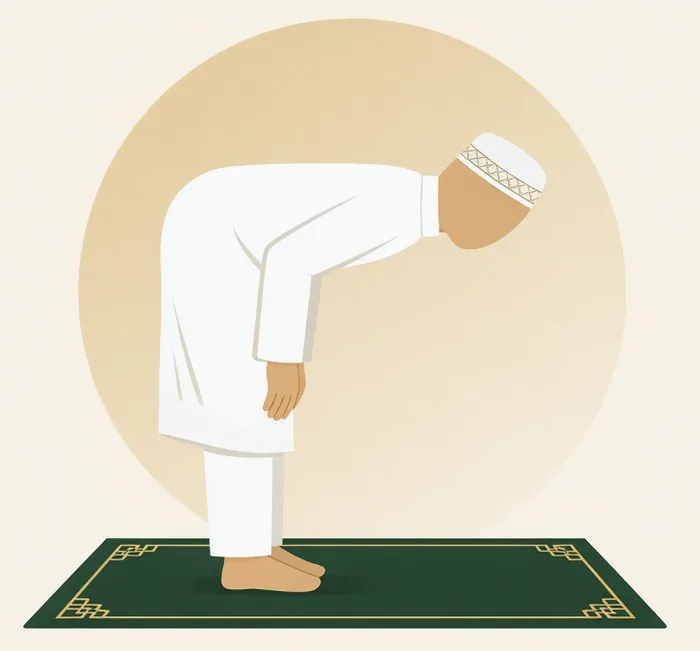
Dhikr in ruku
سُبْحَانَ رَبِّيَ الْعَظِيمِ
Subḥāna Rabbiya-l-'Aẓīm — "Glory be to my Lord, the Most Great."
This is reported from the Prophet ﷺ in Sahih Muslim 772. It is commonly said three times (or more, in an odd number).
Step 7: Stand up from ruku
Rise back to standing, saying:
Dhikr when rising
سَمِعَ اللَّهُ لِمَنْ حَمِدَهُ
Sami'a-llāhu li-man ḥamidah — "Allah hears the one who praises Him."
Once standing straight, say the reply:
رَبَّنَا لَكَ الْحَمْدُ
Rabbanā laka-l-ḥamd — "Our Lord, to You belongs all praise."
Both are reported in Sahih Muslim 772 and Sahih al-Bukhari 795–796. Other authentic wordings include Rabbanā wa laka-l-ḥamd and Allāhumma Rabbanā laka-l-ḥamd; any of them is fine. When praying behind an imam, the imam says Sami'a-llāhu li-man ḥamidah and the followers reply Rabbanā laka-l-ḥamd.
Pause here until you are fully upright and settled before moving on.
Step 8: Prostrate (Sujood)
Say Allāhu akbar and go down into prostration. Seven parts of the body touch the ground: the forehead together with the nose, both palms, both knees and the toes of both feet. Keep your fingers together and pointing towards the qiblah. Say:
Dhikr in sujood
سُبْحَانَ رَبِّيَ الْأَعْلَىٰ
Subḥāna Rabbiya-l-A'lā — "Glory be to my Lord, the Most High."
This is also reported in Sahih Muslim 772, and is commonly said three times.
Step 9: Sit between the two prostrations (Jalsah)
Say Allāhu akbar and rise to a sitting position, resting your hands on your thighs. Sit calmly for a moment. Many people say:
Dua between the prostrations
رَبِّ اغْفِرْ لِي
Rabbi-ghfir lī — "My Lord, forgive me." (Sunan Ibn Majah 897, graded sahih by Darussalam)
Step 10: Make the second prostration
Say Allāhu akbar and prostrate again exactly as before, saying Subḥāna Rabbiya-l-A'lā. This completes one rak'ah.
Step 11: Complete the remaining rak'ahs
Say Allāhu akbar and stand up for the second rak'ah. Repeat steps 4 to 10: Al-Fatihah, another surah, ruku, standing, two prostrations.
After the second prostration of the second rak'ah, sit instead of standing.
- In a two-rak'ah prayer (such as Fajr), this is the final sitting: go straight to Step 12.
- In a three- or four-rak'ah prayer (Maghrib, Dhuhr, Asr, Isha), this is the middle sitting. Recite the tashahhud (below) and then stand up for the third rak'ah with Allāhu akbar. In the third and fourth rak'ahs of the fard prayer, you recite only Al-Fatihah, without an additional surah. After the last rak'ah, sit for the final sitting.
Step 12: Final sitting, tashahhud and salam
Sit and recite the tashahhud. A widely used wording, taught by the Prophet ﷺ to 'Abdullah ibn Mas'ud and followed in the Hanafi school, is:
Dhikr: Tashahhud (Sahih al-Bukhari 831, 6265)
التَّحِيَّاتُ لِلَّهِ وَالصَّلَوَاتُ وَالطَّيِّبَاتُ، السَّلَامُ عَلَيْكَ أَيُّهَا النَّبِيُّ وَرَحْمَةُ اللَّهِ وَبَرَكَاتُهُ، السَّلَامُ عَلَيْنَا وَعَلَىٰ عِبَادِ اللَّهِ الصَّالِحِينَ، أَشْهَدُ أَنْ لَا إِلَٰهَ إِلَّا اللَّهُ، وَأَشْهَدُ أَنَّ مُحَمَّدًا عَبْدُهُ وَرَسُولُهُ
At-taḥiyyātu lillāhi wa-ṣ-ṣalawātu wa-ṭ-ṭayyibāt. As-salāmu 'alayka ayyuha-n-nabiyyu wa raḥmatu-llāhi wa barakātuh. As-salāmu 'alaynā wa 'alā 'ibādi-llāhi-ṣ-ṣāliḥīn. Ash-hadu an lā ilāha illa-llāh, wa ash-hadu anna Muḥammadan 'abduhū wa rasūluh.
Meaning: "All greetings, prayers and good things are for Allah. Peace be upon you, O Prophet, and the mercy of Allah and His blessings. Peace be upon us and upon the righteous servants of Allah. I bear witness that there is no god but Allah, and I bear witness that Muhammad is His servant and Messenger."
Other authentic wordings of the tashahhud exist and are used in other schools. Many worshippers raise the right index finger during the testimony; how and when differs by school.
In the final sitting, continue with the salawat (blessings on the Prophet ﷺ), known as Ṣalāh Ibrāhīmiyyah:
Dhikr: Salawat (Sahih al-Bukhari 3370)
اللَّهُمَّ صَلِّ عَلَىٰ مُحَمَّدٍ وَعَلَىٰ آلِ مُحَمَّدٍ، كَمَا صَلَّيْتَ عَلَىٰ إِبْرَاهِيمَ وَعَلَىٰ آلِ إِبْرَاهِيمَ، إِنَّكَ حَمِيدٌ مَجِيدٌ. اللَّهُمَّ بَارِكْ عَلَىٰ مُحَمَّدٍ وَعَلَىٰ آلِ مُحَمَّدٍ، كَمَا بَارَكْتَ عَلَىٰ إِبْرَاهِيمَ وَعَلَىٰ آلِ إِبْرَاهِيمَ، إِنَّكَ حَمِيدٌ مَجِيدٌ
Allāhumma ṣalli 'alā Muḥammadin wa 'alā āli Muḥammad, kamā ṣallayta 'alā Ibrāhīma wa 'alā āli Ibrāhīm, innaka Ḥamīdun Majīd. Allāhumma bārik 'alā Muḥammadin wa 'alā āli Muḥammad, kamā bārakta 'alā Ibrāhīma wa 'alā āli Ibrāhīm, innaka Ḥamīdun Majīd.
Meaning: "O Allah, send Your mercy on Muhammad and on the family of Muhammad, as You sent Your mercy on Ibrahim and on the family of Ibrahim; You are the Most Praiseworthy, the Most Glorious. O Allah, send Your blessings on Muhammad and on the family of Muhammad, as You sent Your blessings on Ibrahim and on the family of Ibrahim; You are the Most Praiseworthy, the Most Glorious."
You may then make a short dua. Many people recite this dua from the Quran:
Quran, Al-Baqarah 2:201 (as a dua)
رَبَّنَآ ءَاتِنَا فِى ٱلدُّنْيَا حَسَنَةً وَفِى ٱلْـَٔاخِرَةِ حَسَنَةً وَقِنَا عَذَابَ ٱلنَّارِ
Rabbanā ātinā fi-d-dunyā ḥasanatan wa fi-l-ākhirati ḥasanatan wa qinā 'adhāba-n-nār — "Our Lord, give us in this world [that which is] good and in the Hereafter [that which is] good and protect us from the punishment of the Fire."
Finally, end the prayer by turning your head to the right and then to the left, saying each time:
Dhikr: Salam
السَّلَامُ عَلَيْكُمْ وَرَحْمَةُ اللَّهِ
As-salāmu 'alaykum wa raḥmatu-llāh — "Peace be upon you, and the mercy of Allah."
The Prophet ﷺ gave the salam to his right and to his left (Sahih Muslim 582; Sunan Abi Dawud 996). Your prayer is now complete.
"Pray as You Have Seen Me Praying"
Muslims do not invent their own way of praying. The Prophet ﷺ taught Salah by example, and he told his Companions to follow it:
Hadith, Sahih al-Bukhari 631 (narrated by Malik ibn al-Huwayrith): "Pray as you have seen me praying and when it is the time for the prayer one of you should pronounce the Adhan and the oldest of you should lead the prayer."
This is why the details of Salah were passed down so carefully through every generation, and why learning from a teacher who can watch and correct you is so valuable.
The Spiritual Benefits of the Five Daily Prayers
The Prophet ﷺ described the five daily prayers with a memorable picture:
Hadith, Sahih Muslim 668 (narrated by Jabir): "The similitude of five prayers is like an overflowing river passing by the gate of one of you in which he washes five times daily." (One of the narrators, al-Hasan, added: "No filthiness can remain on him.")
He also explained that the prayers wipe away minor sins committed between them:
Hadith, Sahih Muslim 233a (narrated by Abu Huraira): "Five prayers and from one Friday prayer to (the next) Friday prayer is an expiation (of the sins committed in between their intervals) if major sins are not committed."
Note the condition at the end: the prayers expiate minor sins, while major sins need sincere repentance.
Many Muslims also describe practical blessings from praying on time, such as a daily rhythm and regular pauses for gratitude. These are personal experiences rather than promises.
How Many Rak'ahs Are in Each Salah?
A rak'ah is one complete unit of prayer: standing, recitation, ruku, standing again and two prostrations. Here is how many rakats are in each fard Salah:
| Prayer | Fard rak'ahs | Where the sittings are |
|---|---|---|
| Fajr | 2 | Final sitting after rak'ah 2 |
| Dhuhr | 4 | Middle sitting after rak'ah 2, final after rak'ah 4 |
| Asr | 4 | Middle sitting after rak'ah 2, final after rak'ah 4 |
| Maghrib | 3 | Middle sitting after rak'ah 2, final after rak'ah 3 |
| Isha | 4 | Middle sitting after rak'ah 2, final after rak'ah 4 |
That makes 17 fard rak'ahs a day. Alongside them, Muslims pray extra sunnah rak'ahs that the Prophet ﷺ regularly prayed. The counts below are those commonly taught in the Hanafi school; other schools count some of them differently, so check with your teacher.
- Fajr prayer: 2 sunnah before the 2 fard. The fard of Fajr is recited aloud when praying in congregation.
- Dhuhr prayer: 4 sunnah before and 2 sunnah after the 4 fard. The recitation is silent.
- Asr prayer: 4 fard, recited silently. Some people also pray 4 non-emphasised sunnah before it.
- Maghrib prayer: 3 fard, then 2 sunnah. The first two rak'ahs are recited aloud in congregation.
- Isha prayer: 4 fard, then 2 sunnah, followed by Witr. In the Hanafi school Witr is 3 rak'ahs and considered necessary (wajib); other schools treat Witr as a strongly recommended sunnah with different numbers of rak'ahs.
If you are just starting, focus first on the fard prayers and praying them on time. The sunnah prayers can be added as you grow more confident.
Common Mistakes Beginners Make
Everyone makes mistakes while learning Salah. Knowing the common ones helps you avoid them:
- Rushing. This is the most common mistake. The Prophet ﷺ once told a man who prayed quickly to "go back and pray, for you have not prayed", three times, and then taught him to bow, stand, prostrate and sit "till you feel at ease" in each position (Sahih al-Bukhari 757). Let every position settle before you move.
- Incomplete wudu. Missing part of the arm up to the elbow, or the heels, is easy to do. Wash carefully and fully.
- Mispronouncing Al-Fatihah. Arabic letters such as ح and ه, or ض and د, sound different and carry different meanings. Practise with someone who can correct you.
- Losing count of rak'ahs. If you are unsure how many you have prayed, there is a set way to correct it, the prostration of forgetfulness (sajdah al-sahw). Ask a teacher to show you how it works in your school.
- Praying outside the time. Check a reliable local timetable, especially in UK winters when Dhuhr, Asr and Maghrib are close together.
- Waiting until everything is perfect. Do not delay praying until you have memorised every word. Start with what you know and keep learning. Ask a scholar about what is acceptable while you are still learning.
Many of these mistakes are hard to spot on your own. A qualified teacher who listens to your recitation and checks each step makes a real difference. At Noor Harf, our 1-on-1 Quran classes cover Qaida, Nazra and Tajweed, so you can learn to read what you recite in Salah correctly. You can also book a free trial class to see how lessons work.
How Can Children Learn Salah?
Children usually learn prayer by copying the people around them. A well-known hadith mentions teaching children to pray from the age of seven (Jami' at-Tirmidhi 407; see also Sunan Abi Dawud 495), so many families begin gently at around that age, while younger children often like to join in on their own.
Some practical tips for parents:
- Pray where they can see you. Children copy what they see far more than what they are told.
- Teach in small pieces. Start with the takbir, Al-Fatihah and one short surah, then add ruku, sujood and the tashahhud over weeks, not days.
- Explain the meaning and build a routine. Tell them what the words mean, and link prayers to the day: Fajr before school, Maghrib before dinner.
- Keep it positive. Praise effort, celebrate small wins, and correct mistakes gently and privately.
- Get help with recitation. A patient teacher can help your child read Al-Fatihah and short surahs correctly from the start.
Our Quran course teaches children one-to-one, starting with Qurani Qaida and moving on to Nazra and Tajweed. You can read about our teachers and how we keep children safe.
Frequently Asked Questions About Salah
What is Salah in Islam?
Salah is the formal prayer Muslims perform five times a day. It is one of the five pillars of Islam and includes standing, bowing, prostrating and sitting while reciting the Quran and words of praise in Arabic.
How many times a day do Muslims pray?
Five times: Fajr (dawn), Dhuhr (midday), Asr (afternoon), Maghrib (after sunset) and Isha (night).
How many rak'ahs are in Fajr?
Fajr has 2 fard rak'ahs, usually preceded by 2 sunnah rak'ahs.
How many rak'ahs are in Dhuhr?
Dhuhr has 4 fard rak'ahs. In the Hanafi school, 4 sunnah are prayed before and 2 after.
How many rak'ahs are in Asr?
Asr has 4 fard rak'ahs.
How many rak'ahs are in Maghrib?
Maghrib has 3 fard rak'ahs, usually followed by 2 sunnah.
How many rak'ahs are in Isha?
Isha has 4 fard rak'ahs, usually followed by 2 sunnah and then Witr (3 rak'ahs in the Hanafi school).
What should I learn first before praying Salah?
Learn how to make wudu, the takbir, Surah Al-Fatihah, one short surah, and the words for ruku and sujood. Then learn the tashahhud, the salawat and the salam.
Do I need Wudu before Salah?
Yes. Wudu is a condition of prayer (Quran 5:6). If you have had a major impurity, you need a full bath (ghusl) first.
What should I recite during Salah?
The opening takbir, Al-Fatihah in every rak'ah, another portion of the Quran in the first two rak'ahs, Subḥāna Rabbiya-l-'Aẓīm in ruku, Sami'a-llāhu li-man ḥamidah and Rabbanā laka-l-ḥamd when rising, Subḥāna Rabbiya-l-A'lā in sujood, the tashahhud when sitting, and in the final sitting the salawat, a short dua and the salam.
What is the difference between Salah and Namaz?
There is no difference in the prayer itself. Salah is the Arabic word; Namaz is the word used in Urdu, Persian and Turkish.
How can I teach my child to pray?
Pray in front of them, teach a little at a time, explain the meanings, keep it positive, and get help with correct recitation. Many families begin gently around age seven.
Can I learn Salah online?
Yes. You can learn the steps, recitations and correct pronunciation with a qualified teacher in live online lessons, where the teacher can listen to your recitation and watch your positions. For specific rulings, also ask a scholar or your local imam.
Sources & References
Quran (Arabic text and Saheeh International translation from quran.com)
- Al-Fatihah 1:1–7 — https://quran.com/1
- Al-Baqarah 2:43 — https://quran.com/2/43
- Al-Baqarah 2:144 — https://quran.com/2/144
- Al-Baqarah 2:201 — https://quran.com/2/201
- Al-Baqarah 2:238 — https://quran.com/2/238
- An-Nisa 4:103 — https://quran.com/4/103
- Al-Ma'idah 5:6 — https://quran.com/5/6
- An-Nahl 16:98 — https://quran.com/16/98
- Taha 20:14 — https://quran.com/20/14
- Al-Mu'minun 23:1–2 — https://quran.com/23/1-2
- Al-'Ankabut 29:45 — https://quran.com/29/45
- Al-Ikhlas 112:1–4 — https://quran.com/112
Hadith (English wording from sunnah.com)
- Sahih al-Bukhari 631 — "Pray as you have seen me praying" — https://sunnah.com/bukhari:631 (also narrated at Sahih al-Bukhari 7246 — https://sunnah.com/bukhari:7246)
- Sahih al-Bukhari 756 — no prayer without Al-Fatihah — https://sunnah.com/bukhari:756
- Sahih al-Bukhari 757 — the man told "go back and pray" — https://sunnah.com/bukhari:757
- Sahih al-Bukhari 795, 796 — saying "Rabbana laka al-hamd" — https://sunnah.com/bukhari:795, https://sunnah.com/bukhari:796
- Sahih al-Bukhari 831, 6265 — the tashahhud of Ibn Mas'ud — https://sunnah.com/bukhari:831, https://sunnah.com/bukhari:6265
- Sahih al-Bukhari 3370 — the salawat — https://sunnah.com/bukhari:3370
- Sahih Muslim 233a — the five prayers as expiation — https://sunnah.com/muslim:233a
- Sahih Muslim 582 — the salam to the right and left — https://sunnah.com/muslim:582
- Sahih Muslim 612a — the times of the prayers — https://sunnah.com/muslim:612a
- Sahih Muslim 668 — the river hadith — https://sunnah.com/muslim:668
- Sahih Muslim 772 — the dhikr of ruku, rising and sujood — https://sunnah.com/muslim:772
- Sunan Abi Dawud 61 — the key to prayer is purification (hasan sahih, al-Albani) — https://sunnah.com/abudawud:61
- Sunan Abi Dawud 775, 776 — the opening praise (thana) — https://sunnah.com/abudawud:775, https://sunnah.com/abudawud:776
- Sunan Abi Dawud 996 — the salam (sahih, al-Albani) — https://sunnah.com/abudawud:996
- Sunan Ibn Majah 897 — "Rabbighfir li" between the prostrations (sahih, Darussalam) — https://sunnah.com/ibnmajah:897
- Jami' at-Tirmidhi 407 and Sunan Abi Dawud 495 — teaching children prayer at seven — https://sunnah.com/tirmidhi:407, https://sunnah.com/abudawud:495
This guide explains a common method of prayer for beginners. For detailed rulings, especially where the schools of law differ, please consult a qualified scholar or your local imam.